Views: 0 Author: Site Editor Publish Time: 2026-10-28 Origin: Site
If you reorder in 2026 the same shopping bag you approved in 2024, you may be buying a bag your stores can no longer hand out — or one that fails a load test you never knew existed.
Two things changed at once. Regulation tightened, and the buyers who used to compete on price are now being asked to compete on paperwork. This checklist covers both, so you can qualify a supplier in one conversation instead of three months of samples.
Short answer: California now bans single-use retail plastic carryout bags outright, regardless of thickness. Restaurants are exempt. Twelve US states operate statewide bag laws, and more than 200 counties and municipalities run their own.
That "regardless of thickness" clause is the part most buyers miss. For years, the workaround in California was to specify a heavier film and call the result a reusable bag. The 2026 rule removes that escape hatch: a plastic carryout bag is a plastic carryout bag, whether it is 2 mil or 4 mil.
The second change is quieter and more disruptive. Bag law is no longer one national specification you set once. Twelve states have statewide rules, over two hundred local jurisdictions have their own, and the criteria differ — some regulate film thickness, some regulate durability or capacity, some regulate what material may be distributed at all. If you ship into five states, you may be shipping under five different definitions of "reusable".
None of that means the answer is complicated. It means compliance has moved from the design stage to the purchasing stage, and somebody has to own it.
Reordering last year's SKU is the cheapest decision available and usually the most expensive one. Three failure modes show up repeatedly:
The bag is legal in the state you bought it for, and illegal in the state you just expanded into. Your purchasing system sees one item number; the regulator sees five jurisdictions.
The bag was never load tested, only described as strong. "Durable" is a marketing word. It is not a test result, and it will not survive a buyer complaint about a bag that split at the handle.
The recycled content claim cannot be documented. If your sustainability report says 100% recycled content and the supplier can only produce a verbal assurance, the number is yours to defend, not theirs.
All three are cheap to prevent at the quotation stage and expensive to fix after the container arrives.
These are the questions that separate a supplier who can support your compliance file from one who can only quote a price.
Ask for grams per square metre, not "heavy duty". A specification in g/m² can be measured, compared across suppliers, and written into a purchase contract. Anything else is an adjective. For reusable shopping bags intended to survive repeated grocery loads, weight is the single strongest predictor of service life.
The useful version of this question is not "is it strong" but "who tested it, to what load, and will you give me the record". A supplier who tests to a stated load and issues a report per batch is telling you they expect to be held to it. A supplier who says "very strong, no problem" is telling you the opposite.
"Eco-friendly" is not a specification. Ask for the certification body, the certificate number, and whether a transaction certificate can be issued for your specific order. If the answer is a brochure rather than a certificate, treat the recycled content as unverified — and do not repeat the number in your own sustainability reporting until it is.
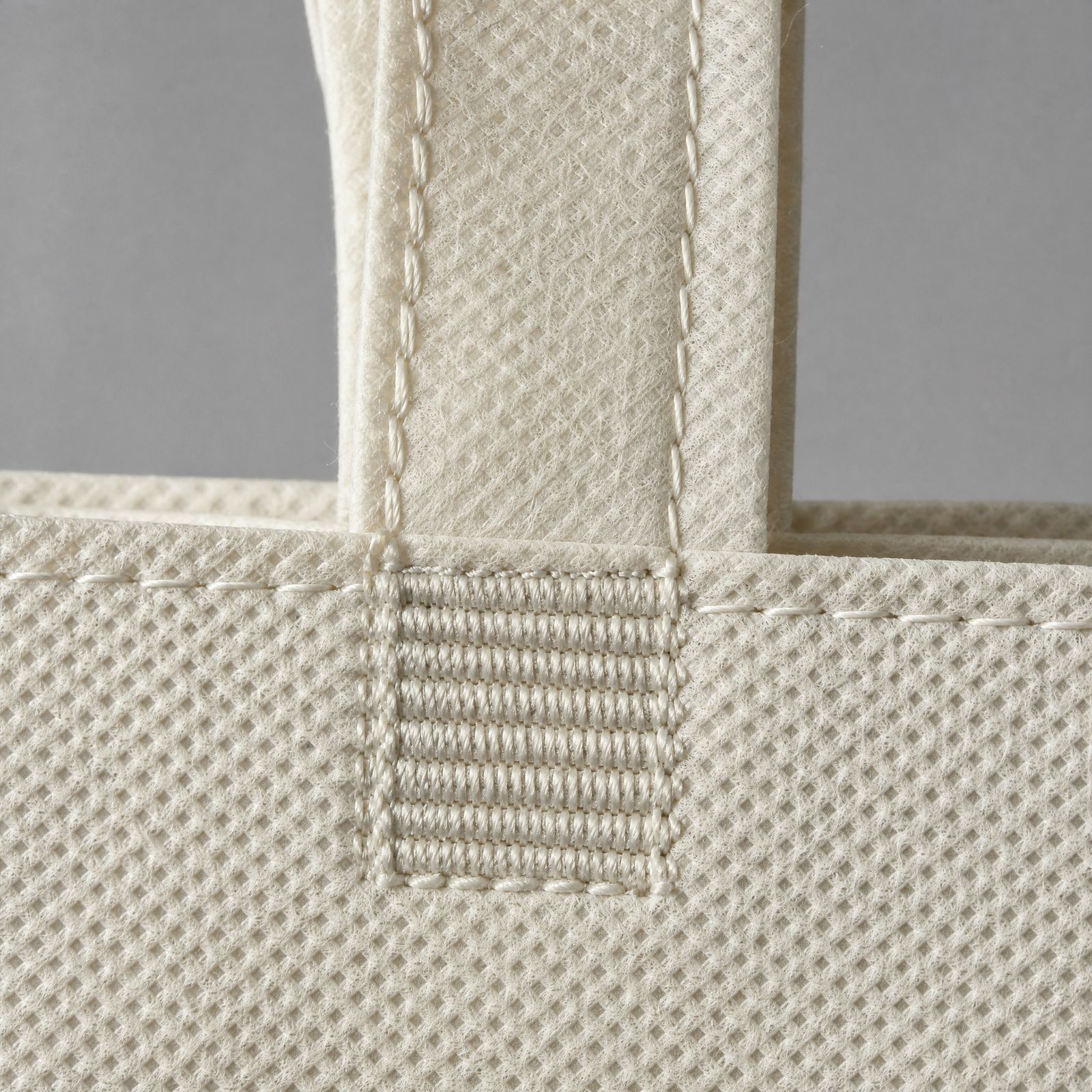
Almost every reusable bag failure happens at one of two places: the handle-to-body junction, or the seam. Ask whether the handle attachment is reinforced with a bar-tack or box stitch, how many stitch rows, and what thread is used. Then ask for a close-up photograph of that junction. A supplier who cannot produce a photo of their own stitch work has not been asked this before.
Digital proofs do not show how ink behaves on non-woven or canvas. Fabric texture shifts colour, and a screen rendering hides it. Insist on a physical pre-production sample for any order where brand colour matters, and confirm in writing that mass production will match the approved sample.
This is the question that most often turns a good quotation into a bad order. A 500-piece MOQ that applies per colour is a 2,500-piece commitment across a five-colour programme. Ask explicitly, and ask what happens to the price if you split colours.
Production time and transit time are different numbers, and suppliers habitually quote the flattering one. Ask for production days after artwork approval, plus sea freight days to your port, plus the buffer they actually recommend. Then ask what happens when artwork approval slips by a week, because it usually does.
Most supplier confusion disappears when the RFQ carries the specification instead of the reply. Send this and you will get comparable quotations.
Field | What to specify |
|---|---|
Intended market | State / country the bag will be distributed in — this drives the compliance question |
Material | Fabric type and recycled content requirement, with certification expected |
Fabric weight | g/m², stated as a minimum |
Dimensions | Width × height × gusset, in cm |
Load rating | Tested load in kg, with report required per batch |
Handle construction | Handle material, width, reinforcement method, stitch rows |
Printing | Method, number of colours, print area, Pantone references |
Sampling | Physical sample required before mass production; sample fee and refund terms |
MOQ | Per colour and per order, stated separately |
Packing | Pieces per carton, carton dimensions, carton weight |
Delivery | Production days, transit days, port, Incoterm |
Thickness quoted in "mils" with no g/m² figure. Film thickness and fabric weight are not interchangeable, and a supplier using the wrong unit is either copying an old template or does not make the product.
No sample policy, or a sample fee with no refund term. Suppliers confident in their production do not hide behind this.
A single lead-time number. Production plus transit plus buffer is three numbers. One number means someone is guessing.
Certification claimed verbally. Ask for the certificate number. A real certification has one.
Load strength described but never tested. If there is no test, there is no result.
No. The 2026 rule bans single-use retail plastic carryout bags regardless of thickness, closing the earlier route of specifying a heavier film. Restaurants are exempt from the ban, but retail distribution is not.
Not automatically. Twelve states have statewide laws and more than 200 local jurisdictions have their own, with different criteria for thickness, durability or permitted material. A bag built to the strictest market you ship into is usually the cheapest way to simplify purchasing — but confirm the specific requirement for each state with your compliance team.
The certification body, the certificate number, and a transaction certificate tied to your order. Without those three, recycled content is a claim rather than a verified figure, and it should not appear in your sustainability reporting.
Unit cost is higher, which is the wrong comparison. A reusable bag is distributed once and used many times, so the correct comparison is cost per shopping trip rather than cost per bag. Ask suppliers for cost per trip at your expected reuse count, and the economics usually reverse.
Production typically runs from artwork approval to packing, then sea freight to your port, then inland delivery. Ask for all three figures separately. Buyers who plan only on production time are the ones paying air freight in December.
We manufacture reusable grocery bags, recyclable shopping bags and custom shopping bags with logo printing for retail and promotional buyers, in non-woven, canvas, oxford and recycled fabrics. Our shopping bag range covers the constructions most US retail programmes specify.
If you are re-specifying a bag for 2026, send us the market you distribute in and the load you need to survive. We will come back with a specification and the test data behind it, rather than a price and an adjective.